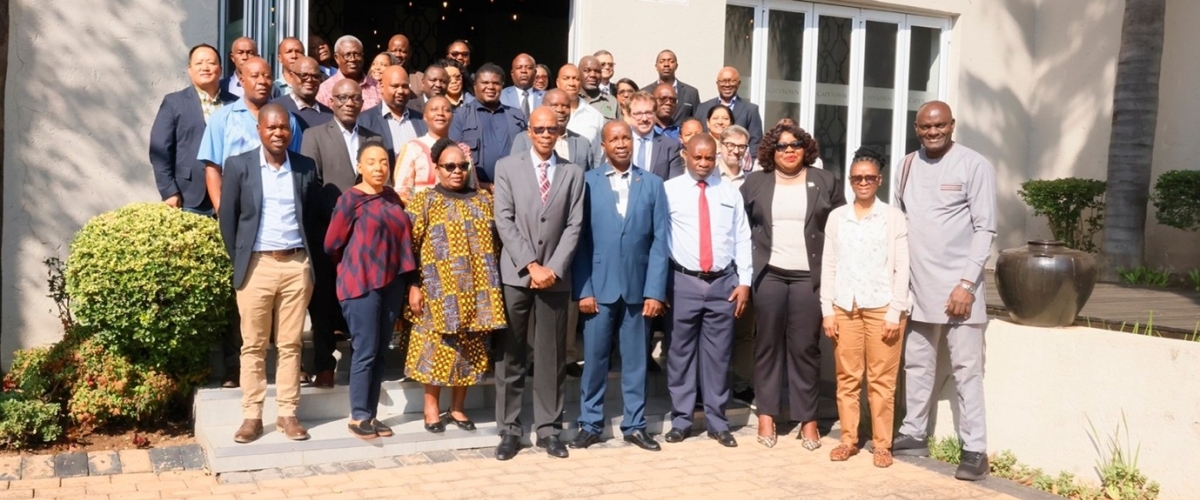
JOHANNESBURG, SOUTH AFRICA, 8–10 APRIL 2026 — Regional experts from across Southern Africa convened in Johannesburg for the Southern African Development Community (SADC) Livestock Technical Committee Meeting to discuss coordinated responses to outbreaks of foot-and-mouth disease (FMD), validate the regional One Health Roadmap, and consider the establishment of an animal genetics gene bank.
CCARDESA coordinated the meeting in collaboration with regional and international partners. It brought together representatives from veterinary services, public health institutions, research organisations and development partners to strengthen collaboration on transboundary animal diseases and advance the One Health approach across the region.
Participants included delegates from SADC Member States and representatives of partner organisations, including the Food and Agriculture Organization of the United Nations, the World Organisation for Animal Health and the Deutsche Gesellschaft für Internationale Zusammenarbeit (GIZ).
During the meeting, representatives of the IKI Growing Greener Project and its consortium partners positioned the Herding for Health approach as a practical vehicle for supporting community-level efforts to prevent and reduce the spread of FMD.
FMD is a highly contagious livestock disease that can spread rapidly when infected and healthy animals mix at communal grazing areas, water points, markets and along livestock movement routes. Although the disease primarily affects animals, its consequences extend throughout the agricultural economy by disrupting livestock production, restricting trade and reducing household incomes.
“The impact of foot-and-mouth disease goes beyond animal health; it affects livelihoods, trade and food security, with losses already reaching hundreds of millions across the region,” said Ms Zvikomborero Tangawamira, the Herding for Health Manager.
For many rural communities, livestock are more than a source of food. They provide income, savings, draught power and social security. Disease outbreaks and livestock-movement restrictions can therefore leave households without access to markets and reduce their ability to meet essential needs.
The Herding for Health approach was presented as offering an opportunity to integrate animal-health management with sustainable grazing, rangeland restoration and improved community livelihoods. Through organised herding, planned livestock movement and cooperation among farmers, communities can better coordinate animal-health practices and manage livestock interactions.
Dr Edmore Masaire , Herding for Health Technical Advisor emphasised that effective disease management requires cooperation among all livestock owners using the same grazing and water resources.
“We must move from individual decision-making to collective action. When farmers share grazing land, they must manage it as one system because, in livestock health, we either win together or lose together,” he said.
Under the approach, livestock owners work together to develop grazing plans, organise herds and strengthen compliance with animal-health measures. These may include coordinated vaccination, dipping and deworming; regular inspection of livestock; early reporting of suspected diseases; controlled livestock movement; and temporary separation of sick or newly introduced animals.
Organised herding can also make it easier for veterinary officers and community animal-health workers to monitor livestock, share information with farmers and respond quickly when signs of disease are detected. At the same time, planned grazing reduces pressure on frequently used areas and allows degraded sections of the rangeland to recover.
The discussions highlighted that precautions taken by individual farmers may be undermined if neighbouring herds are not managed according to the same animal-health standards. Collective action is therefore particularly important in communal production systems where livestock share grazing areas, water points and movement corridors.
The IKI Growing Greener Project promotes Herding for Health as an integrated approach connecting healthy livestock, productive rangelands and resilient livelihoods. By strengthening coordination among farmers, traditional leaders, veterinary services and other local institutions, the approach has the potential to complement government disease-control measures and improve community preparedness.
Consortium representatives called for greater investment in community-based livestock management, animal identification, disease surveillance, veterinary extension and farmer awareness. They also stressed the importance of involving women and young people, who play significant roles in livestock production but may not always participate fully in decisions concerning grazing and animal health.
The discussions reinforced a central message: controlling FMD is not solely the responsibility of veterinary authorities or individual livestock owners. It requires communities, governments and development partners to work collectively across shared landscapes to protect livestock, livelihoods, trade and regional food security.
The meeting concluded with a call for stronger collaboration among governments, research institutions, and development partners to address animal health challenges and strengthen resilient food systems in the region.
Participants agreed that enhanced coordination, investment in veterinary services, and implementation of the One Health Roadmap will be key to safeguarding livestock-dependent livelihoods and regional agricultural development.