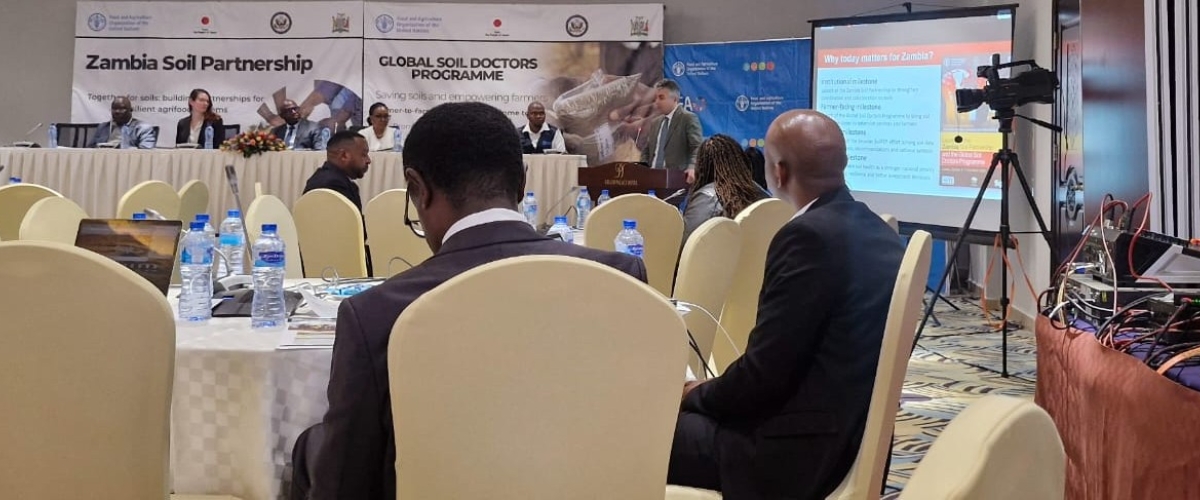
The Centre for Coordination of Agricultural Research and Development for Southern Africa (CCARDESA) participated in the launch of the Zambia Soil Partnership and Global Soil Doctors Programme. The event was funded by the Food and Agriculture Organization of the United Nations under the SoilFER project in collaboration with the United States of America and Japan.
Developed under the GSP framework, the GSDP is a farmer-to-farmer training initiative that equips farmers and extension agents with practical knowledge and tools for sustainable soil management. Trained “soil doctors” support fellow farmers in understanding soil functions, identifying soil threats, and adopting improved soil and fertilizer management practices.
This programme aims to enhance soil management practices, promote sustainable agricultural productivity, and address soil fertility challenges in the region. By integrating local initiatives with regional strategies, it aims to bolster soil health and improve nutrient management, thereby enhancing agricultural resilience and food security.
The FAO Representative in Zambia, Ms. Suze Percy Filippini, expressed gratitude to the United States and the Japanese governments for their continued collaboration with the FAO to promote sustainable agri-food systems and support initiatives that enhance sustainable soil management. She also acknowledged the Ministry's strong leadership in implementing the SoilFER project and for contributing to sustainable soil management practices. “The project is producing positive results that strengthen Zambia's soil management systems by integrating soil data and analytics to inform decision-making,” she added. She emphasized the importance of partnerships that support a coherent national framework to integrate soil management into government processes.
The Soil Doctors programme addresses the challenges of poor soil management through a farmer-to-farmer learning approach, where farmers and extension officials are trained as soil doctors and equipped with practical knowledge and tools to assess soil conditions and recommend soil management practices. This will strengthen the agric extension system and ensure knowledge reaches farmers directly.
Speaking on behalf of the United States Ambassador Representative, Ms Julie Kapuvari, Science and Policy Advisor, U.S. Department of State, kicked off her remarks by highlighting that agri-food systems are at risk from climate change, pests, and diseases. She emphasized the importance of sustainable land management, appropriate fertilizer use, and selecting high-quality seeds. She stated, “Healthy soils are not just about productivity; they are essential for overall ecosystem health and resilient production systems.” Additionally, she remarked, "Maintaining soil health is crucial for sustainable agriculture; healthy soils enhance nutrient availability and optimize crop yield, leading to resilient agricultural systems and thriving communities." She expressed gratitude to the technical staff who worked diligently on implementing the SoilFER project. This program is significant in Zambia, the USA, and worldwide. She highlighted three things that are important for food security work: i) Advanced scientific methodologies, innovative practices, soil mapping techniques, and digital platforms are critical tools that enhance farmers' access to vital information; ii) data analytics revolutionizes agricultural practices by converting soil data into actionable advisories that are effectively communicated to farmers; and iii) aligning goals, SoilFER exemplifies the collaborative efforts between international and local agricultural partners to bolster farmer support, enhance food security, and foster strategic partnerships. She concluded her speech by saying, “Soil health is not about agriculture but also about people”.
The Permanent Secretary for Technical Services, Ministry of Agriculture, Zambia, Mr. John A. Mulongoti, was represented by the Zambia Agriculture Research Institute (ZARI), Dr. Ndashe Kapulu. In his remarks, he said, “The Soil Partnership and Soil Doctors programme will improve technical capacity and empower farmers with knowledge on sustainable soil management practices”. The Soil Partnerships and Soil Doctors programme aligned well with our government's developmental agenda, outlined in the National Development Plan, which recognizes agriculture as the key sector for development and job creation. He further added that, “the two programs are strategically aligned with the Comprehensive Agriculture Transformation Support Programme (CATSP) by enhancing soil health and increasing soil productivity”. He declared the workshop officially opened.
Ms. Futhi Magagula, the Special Projects Coordinator at CCARDESA, delivered a presentation on the SADC Soil Health and Fertiliser Hub, emphasizing CCARDESA's mandate from SADC to establish the regional hub and support the formation of national soil health and fertilizer hubs. She noted that the Operational Plan and Programme documents received approval from the Council of Ministers responsible for Agriculture.
Ms. Magagula highlighted CCARDESA's ongoing efforts to aid Botswana and Lesotho in developing their respective strategies and action plans for soil health and fertilizer management. Additionally, she mentioned engaging in bilateral discussions with Malawi and Zambia to pursue similar initiatives. She underscored the importance of CCARDESA's role in coordinating and harmonizing soil health and fertilizer interventions among technical partners supporting member states.
To prevent redundancy and ensure efficient resource allocation, she stressed the necessity for cohesive support and initiatives within countries. Ms. Magagula acknowledged the contributions of FAO, AFAP, AUDA-NEPAD, and SADC to the development of the foundational documents. Furthermore, she expressed gratitude to FAO and the U.S. government for their support for the Soil Partnership and Soil Doctors programme in Zambia, which plays a pivotal role in enhancing soil health.
Ms. Magagula’s participation was supported by the World Bank funded Food System Resilience Programme coordinated by CCARDESA.