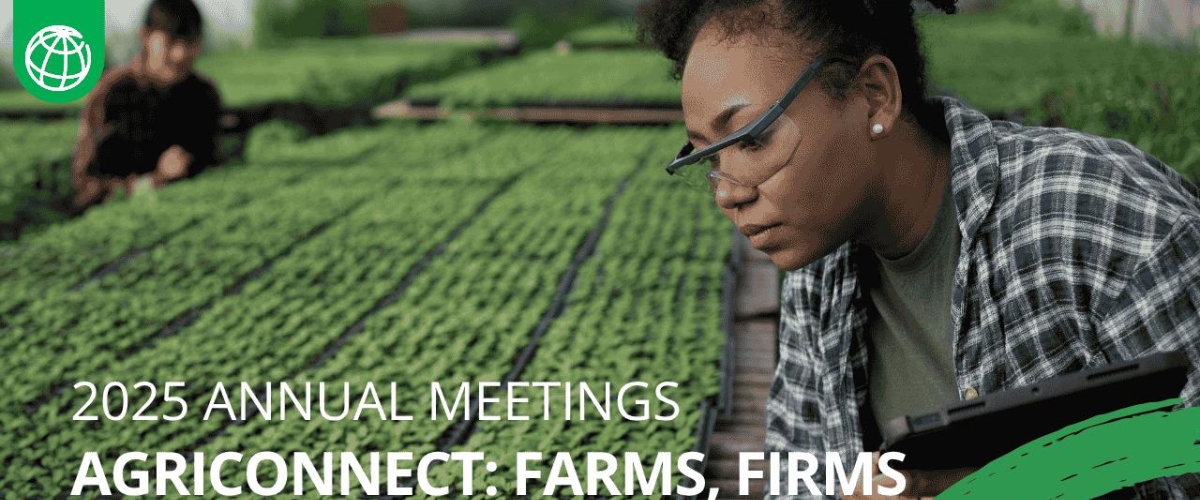
The World Bank has launched AgriConnect, a bold new initiative set to transform smallholder agriculture into a dynamic engine for creation of jobs, boosting investment, and promoting resilience across the developing world. The announcement came on 14 October 2025 during the World Bank–IMF Annual Meetings under the theme “Farms, Firms, and Finance for Jobs.”
AgriConnect seeks to close long-standing gaps in smallholder farming by linking finance, technology, infrastructure, and markets under one coordinated framework. The initiative represents a shift in how the World Bank approaches agricultural transformation, connecting farmers more directly with markets, credit, and innovation.
“This is about connecting farms to firms, and finance to people, so that smallholders are not just producers, but full participants in a thriving food economy,” said Ajay Banga, World Bank Group President.
More than 500 million smallholder farmers feed much of the world but remain constrained by low productivity and poor access to finance and markets. AgriConnect aims to change this by doubling annual investment in agribusiness and agri-finance to USD 9 billion by 2030. With 1.2 billion young people expected to join the workforce in developing countries by the same year, modernizing agriculture could become a major driver of inclusive growth.
Promise for Southern Africa
In Southern Africa, agriculture remains a backbone of most economies, contributing about USD 171 billion (11.8 % of GDP) in 2023, according to the SADC Macroeconomic Statistics Bulletin. With that foundation, AgriConnect could open fresh avenues for digital innovation, market access, and youth employment across the region.
The initiative aims to:
- Expand access to digital tools like climate advisory and e-finance platforms;
- Strengthen value chains and infrastructure through public–private partnerships;
- Create cross-border market linkages; and
- Advance gender and youth inclusion in agriculture.
Still, experts warn that institutional weaknesses, connectivity gaps, and policy fragmentation could slow progress unless countries coordinate regionally.
CCARDESA and FSRP: Turning Vision into Action
The Centre for Coordination of Agricultural Research and Development for Southern Africa (CCARDESA), through the Food Systems Resilience Programme (FSRP), is well placed to turn the World Bank’s vision into regional action.
As SADC’s hub for agricultural research, innovation, and knowledge management, CCARDESA works across 16 member states to advance climate-smart agriculture, data-driven decision-making, and policy harmonization. Through platforms like the CCARDESA Knowledge Hub and its network of Information, Communication, and Knowledge Management (ICKM) focal points, CCARDESA can help to align national programmes with AgriConnect’s goals and foster regional collaboration, including engagement with the private sector. CCARDESA also convenes the Forum of SADC Directors of Agricultural Research and Extension and the Deans of Faculties of Agriculture, strengthening coordination and knowledge exchange across the region.
As AgriConnect takes off, its success will hinge on strong partnerships, policy coherence, and sustained investment in innovation and institutional capacity. With its mandate and technical reach, CCARDESA, through FSRP, is positioned to drive this transformation, ensuring that initiatives such as AgriConnect deliver, not only higher productivity, but also resilience, opportunities, and shared prosperity across Southern Africa.